Why Choose TFT LCD for Automotive Displays?
In the era of smart cars, vehicle displays have become a key component that determines the user experience. Faced with complex in-vehicle environments—from the scorching heat of summer to the freezing cold of winter, from intense sunlight reflection to continuous vehicle vibrations—display modules must possess extremely high reliability and environmental adaptability. After years of validation in automotive applications, TFT LCD technology has established comprehensive advantages in brightness, lifespan, anti-interference capabilities, and cost control. This article will discuss "Why TFT LCD is the preferred choice for automotive displays" from four dimensions: changing demand, technological advantages, recommended solutions, and partners.
The Changing Requirements and Challenges for Automotive Displays
1.Market and Technological Trends Driving Demand Upgrades
From Display to Interaction: In-vehicle screens have evolved into intelligent interactive centers integrating entertainment, control, and driver assistance.
Multi-Screen and Larger Screens: Multi-screen collaboration between the central control unit, instrument panel, passenger side, rear entertainment system, and HUD has become mainstream.
Aesthetic Design: Curved, borderless, and hidden screens place higher demands on module structures.
2. Increasing Core Performance Requirements
High Brightness and Sunlight Readability: Brightness needs to reach 800~1500 nits, with anti-glare technology.
Wide Temperature Range: Adaptable to extreme temperatures from -30℃ to above 85℃, ensuring long-term stable operation.
High Reliability: Vibration-resistant, shock-resistant, moisture-proof, dust-proof, with a service life of 5~10 years or more.
3. Current Challenges
Electromagnetic Compatibility (EMC): Requires rigorous testing to avoid interference with in-vehicle electronic systems.
Integrated Touchscreen: Balancing touch sensitivity with prevention of accidental touches, anti-glare, and no air bubbles in the adhesive.
Long supply cycle: With a vehicle production cycle of 5-7 years, modules require long-term supply and design continuity.
Cost control: While improving performance, it is necessary to consider the increasingly stringent BOM cost pressures from OEMs.
Key Advantages of TFT LCD Technology for Automotive Applications
1. Excellent Optical Performance
High brightness (800–1500 nits) + anti-glare technology for sunlight readability
Wide viewing angle (≥80°) for clear visibility from any seat
High contrast ratio (≥1000:1) and good color reproduction
2. Wide Operating Temperature Range
Stable operation from -30°C to +85°C (some designs可达 -40°C to +95°C)
Better high-temperature and high-humidity tolerance than OLED
3. High Reliability and Durability
Vibration resistant, shock resistant, moisture proof, dust proof
Service life of 5–10+ years with no burn-in risk
4. Flexible Integration Capability
Supports capacitive/resistive touch, optical bonding, anti-reflection treatment
Compatible with LVDS/RGB/MIPI/eDP interfaces for easy connection to automotive SoCs
5. Controllable EMC Performance
Passes automotive EMC standards such as CISPR 25 and ISO 11452
6. Significant Cost Advantage
BOM cost is 30%–50% lower than OLED for equivalent specifications
7. Long-Term Supply Stability
Committed to 5–10+ years of stable supply to meet long automotive lifecycles
Recommended Solution – Vehicle-Specific TFT LCD Display
To meet the diverse display needs of smart cockpits, we recommend using TFT LCD display modules specifically designed for automotive applications. This solution has been comprehensively optimized in terms of optical performance, environmental adaptability, structural flexibility, and reliability, meeting the stringent requirements of mainstream vehicle models for their displays.
Applicable Scenarios
This solution is widely applicable to core scenarios for in-vehicle displays, including:
Instrument Panel: As the core output window for driving information, it requires high reliability, fast response, and wide-temperature operating capability.
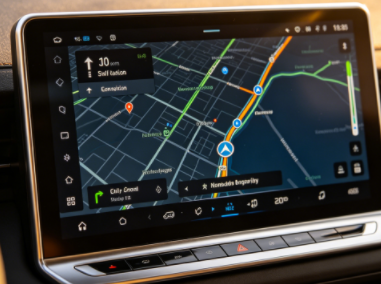
Central Control Screen: Integrating navigation, entertainment, and vehicle settings, it requires high brightness, sensitive touch, and excellent anti-glare performance.
Rear-Seat Entertainment: Providing passengers with an audio-visual entertainment experience, it emphasizes wide viewing angles, color performance, and low power consumption design.
Head-Up Display (HUD): Projecting key driving information onto the windshield, it requires ultra-high brightness, high contrast, and minimal optical distortion.
Product Features
Anti-glare: Effectively reduces ambient light reflection, ensuring clear readability even in direct sunlight.
Full Lamination: Eliminates air gaps, reduces reflections, prevents fogging, and improves touch accuracy.
High Brightness (≥1000 nits): Remains vibrant and eye-catching even in strong light.
Wide Voltage Support: Adapts to fluctuations in automotive electrical systems, simplifying system integration.
Customization Capabilities: Supports flexible customization of interfaces (LVDS/RGB/MIPI), shape, cover plate, lamination method, and frame structure, adaptable to the personalized cockpit designs of different vehicle models.
Reliability Guarantee: Product design conforms to AEC-Q100 automotive-grade standards, passing critical tests such as high temperature, low temperature, temperature cycling, and ESD. A long-term stable supply guarantee of 5-10 years or more is provided to avoid project risks caused by component discontinuation.
Customization Capabilities
Supports flexible customization of interfaces (LVDS/RGB/MIPI), shape, cover plate, bonding method, and frame structure to adapt to the personalized cockpit designs of different vehicle models.
Reliability Assurance
Product design conforms to AEC-Q100 automotive-grade standards and has passed critical tests such as high temperature, low temperature, temperature cycling, and ESD. Furthermore, a long-term stable supply guarantee of 5-10 years or more is provided to avoid project risks caused by component discontinuation.
Why choose to partner with Hello Lighting Co., Ltd.?
Founded in 2010, Hello Lighting Co., Ltd. specializes in the R&D, manufacturing, and sales of TFT LCD display modules, serving high-reliability industries such as automotive, industrial automation, medical equipment, defense, aerospace, drones, and shipbuilding. Located in Shenzhen, the company boasts a 2,000-square-meter modern factory, including an 800-square-meter Class 1000 cleanroom, a reliability laboratory, and a humidity-controlled warehouse, with a monthly production capacity of 200,000 to 300,000 units. Adhering to the core principles of "innovation, reliability, and customization," we are committed to providing display solutions that meet global quality standards and are a trustworthy long-term partner.